Independent executive advisory
AI, Technology and
Product Consulting
for Enterprises
Zug, Switzerland
Find out what is possible.
Start with a 30-minute discovery conversation. Request a call-back, or book a call directly. If there is a strong fit, I will organise a complimentary focused assessment of your enterprise, identifying the key constraints, opportunities and practical next moves.
 LinkedIn profile
Opportunity
The AI opportunity is real. So is the execution gap.
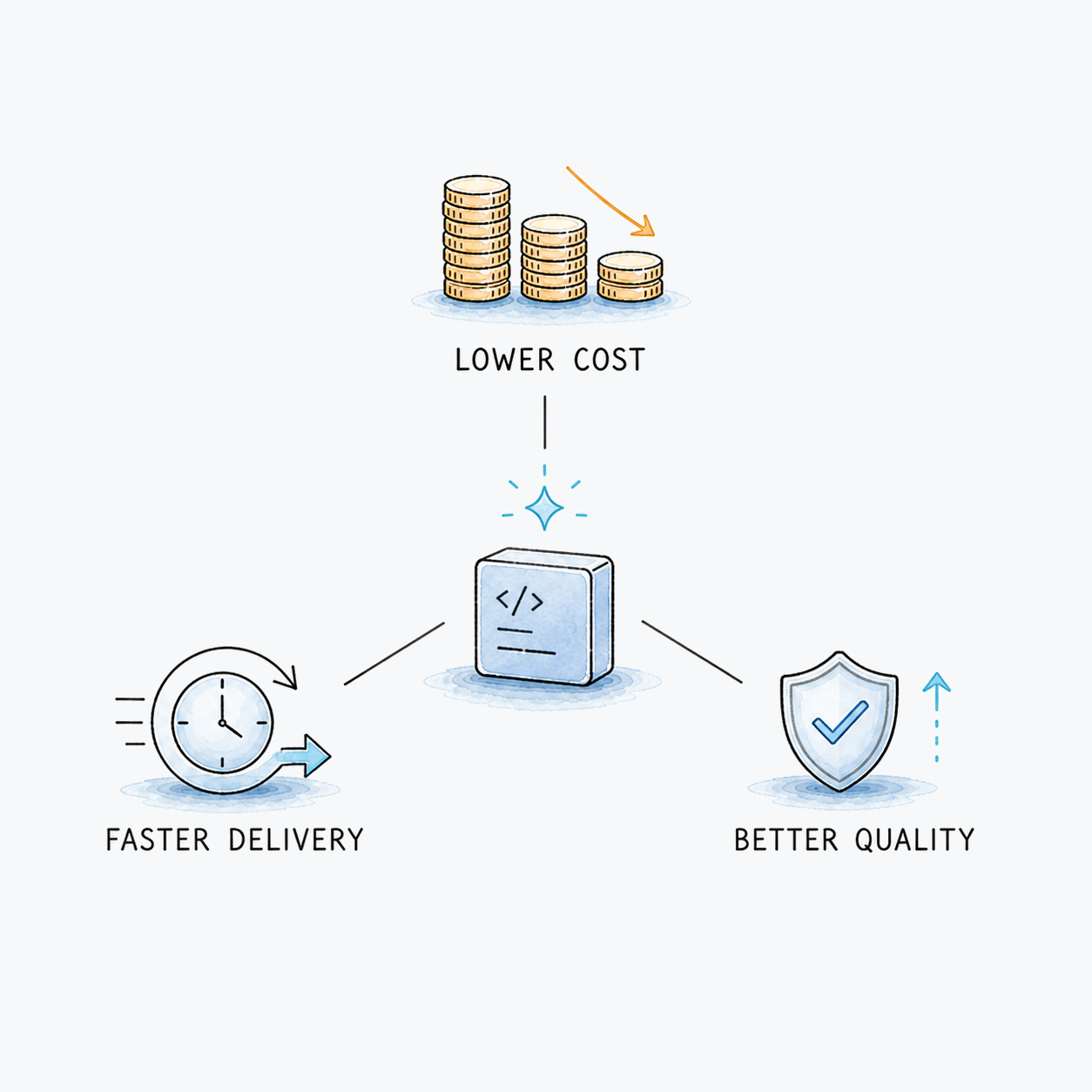
AI has changed the economics of software delivery.
Software can now be built, tested and modernised faster—with less engineering effort.
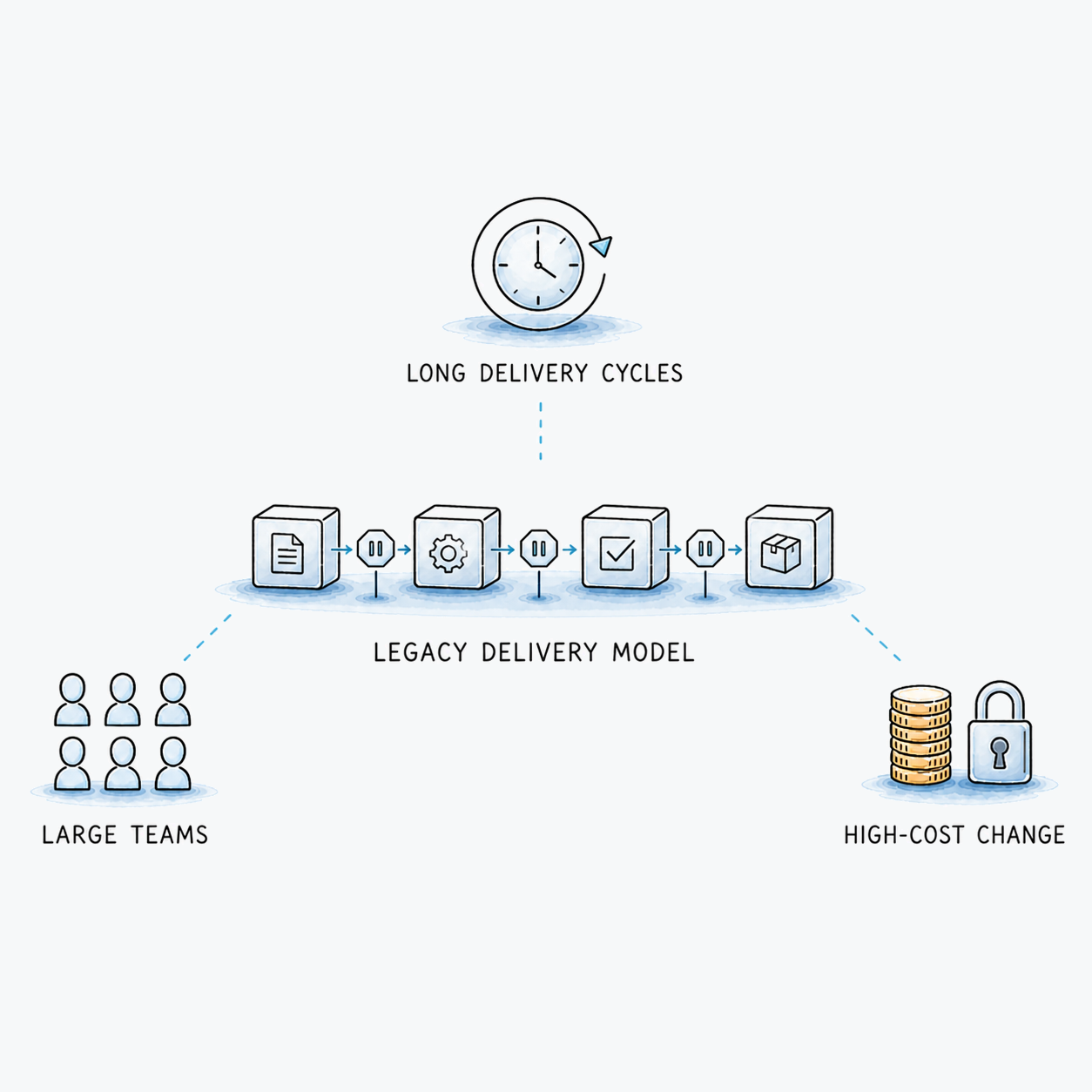
Most enterprises are still operating the old model.
Large teams, long delivery cycles and expensive change programmes remain the norm.
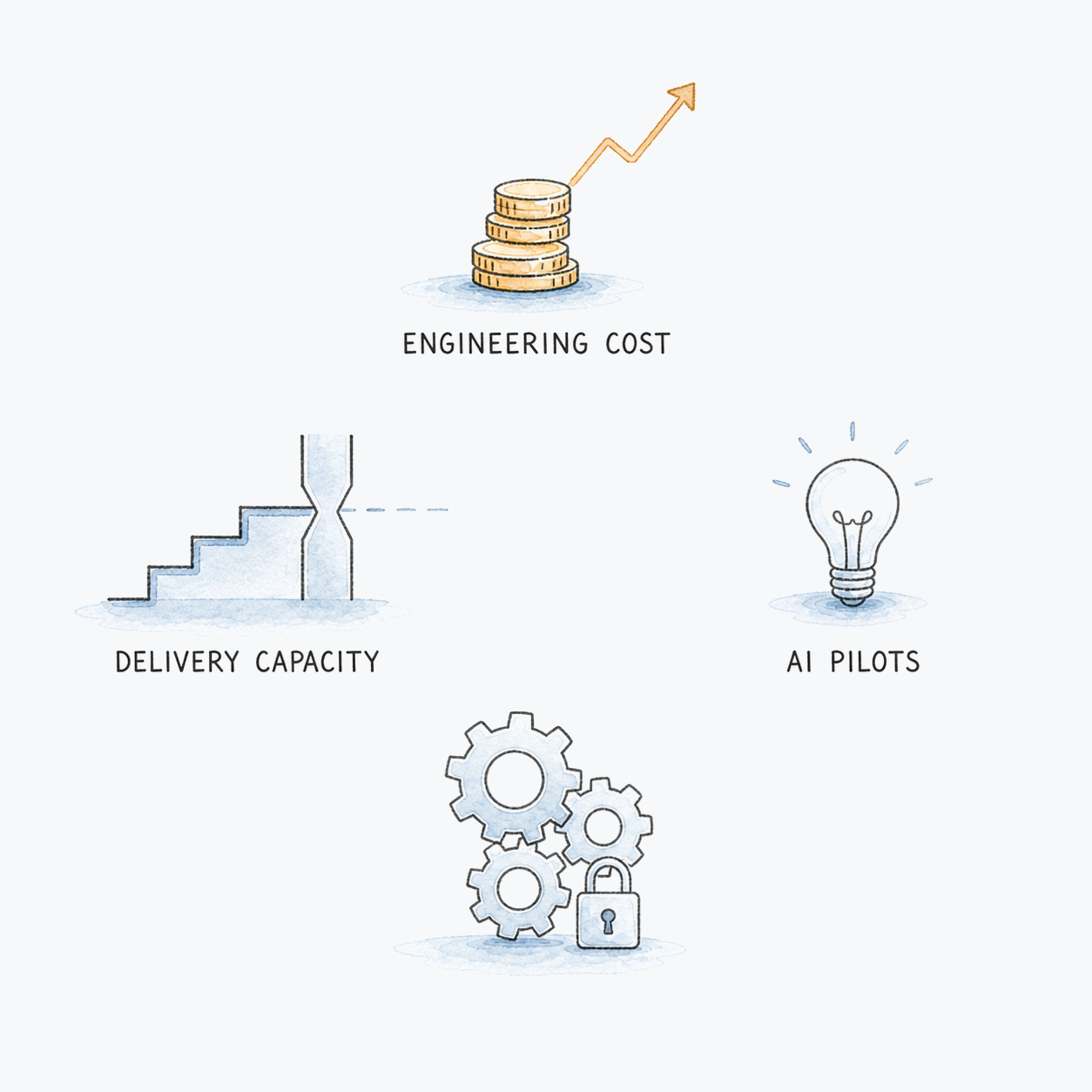
The symptoms are familiar.
Engineering cost rises faster than delivery capacity. AI pilots exist, but delivery has not materially improved. Core platforms are too difficult or risky to change.
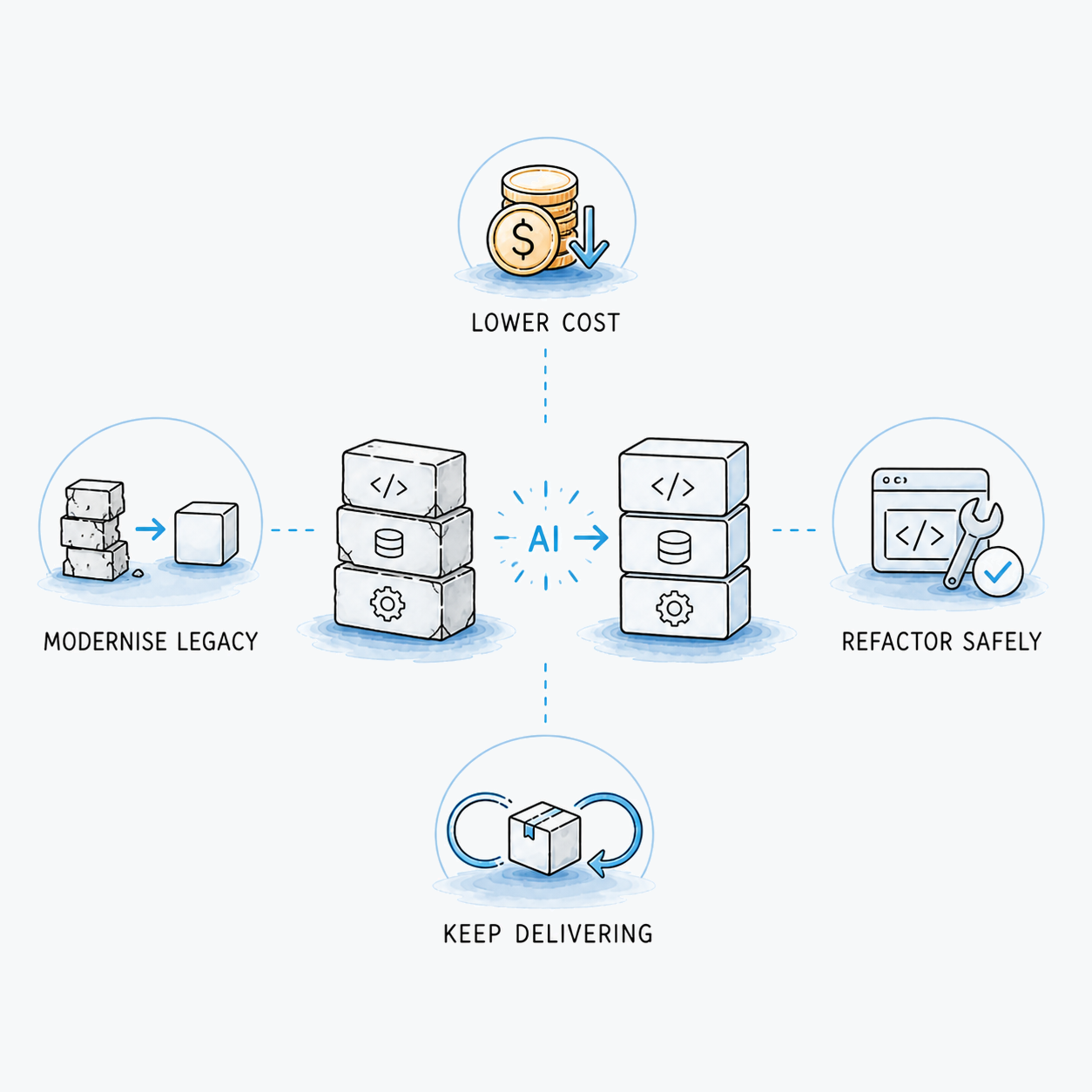
The opportunity is already inside your organisation.
AI can make legacy modernisation, refactoring and day-to-day delivery faster—without pausing the business.
Real-world examples
AI-enabled delivery in practice.
Real examples from my experience showing how AI can reduce delivery cost, accelerate change and give organisations greater control of critical technology.
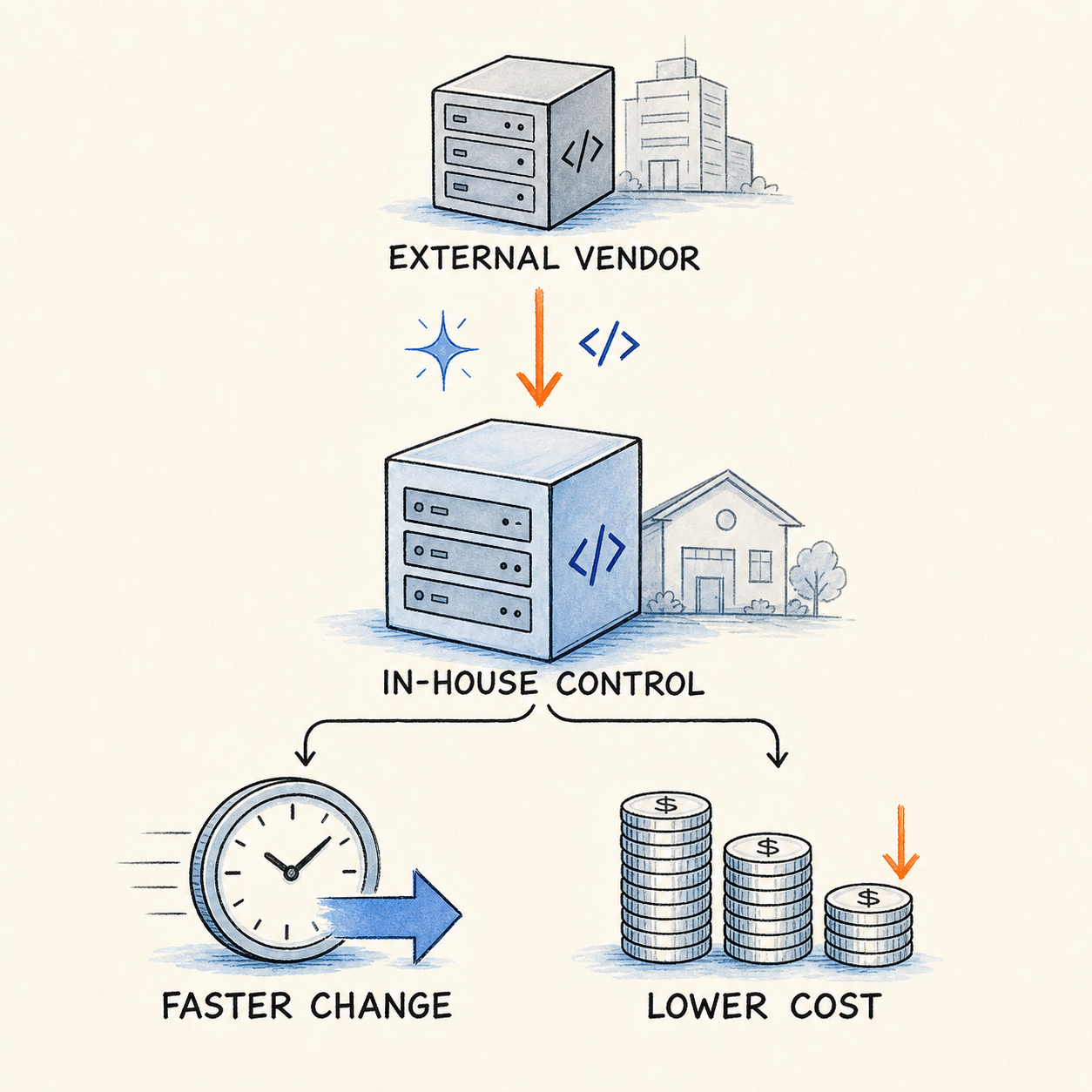 Bringing a core enterprise system in-house
Delivery result: a business-critical system was brought in-house. Time saving: approximately 50% faster (around one month saved per feature). Annual operating-cost saving: approximately 72%. Annual feature-delivery saving: CHF 360,000 in avoided external feature-delivery cost.
Bringing a core enterprise system in-house
Delivery result: a business-critical system was brought in-house. Time saving: approximately 50% faster (around one month saved per feature). Annual operating-cost saving: approximately 72%. Annual feature-delivery saving: CHF 360,000 in avoided external feature-delivery cost.
The challenge
A core enterprise solution had been developed by an external vendor over two years at a cost of approximately CHF 400,000. Continuing ownership cost around CHF 41,120 per year: approximately CHF 20,000 in per-device licences, which increased as the number of connected IoT devices grew, plus vendor support at CHF 220 per hour. A requested new feature was estimated at two months and CHF 60,000. At that rate, a year of continuous feature work would have cost CHF 360,000.
The approach
- The internal DevOps team used AI coding agents to set up the AWS infrastructure and deploy the solution.
- AI-assisted code analysis helped the team understand the codebase and estimate the requested feature.
- An internal engineer used AI coding agents to implement, test and deploy the feature.
The outcome
- Around CHF 30,000 (72%) lower annual ownership cost: including AWS and internal DevOps effort, compared with CHF 41,120 previously.
- 50% faster feature delivery: one month, including testing and deployment, compared with two months.
- CHF 360,000 annual feature-delivery saving: continuous external feature work was no longer required.
The adoption challenge
The internal DevOps team initially hesitated to take ownership of vendor-built code and needed to invest time in deployment. AI-assisted analysis quickly built confidence, while the service continued to meet its required SLA.
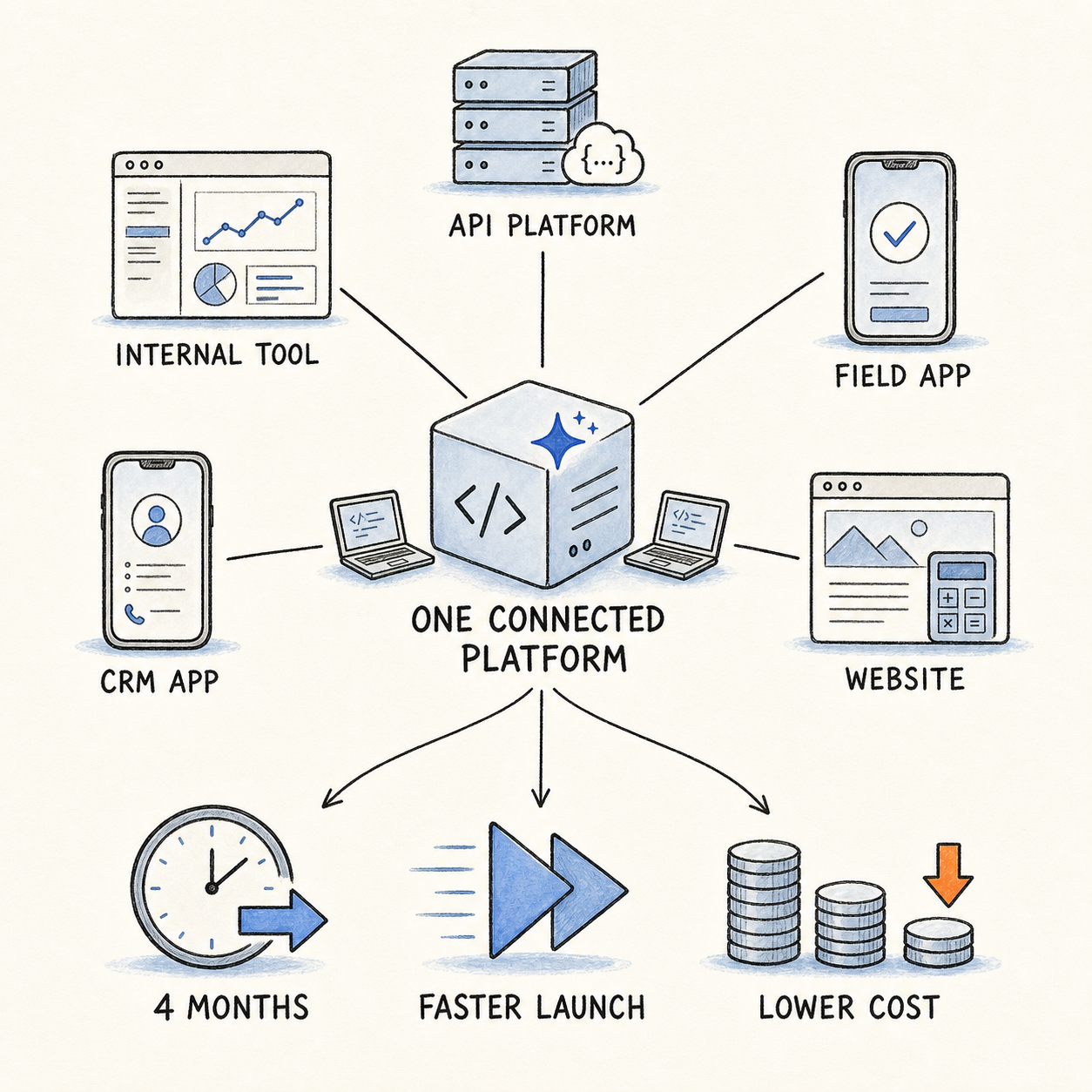 Delivering a complete operating platform
Delivery result: five connected products were delivered by two full-stack engineers in four months. Time saving: approximately 70% faster (around 12 months saved). Cost saving: approximately 85% (around CHF 300,000 saved).
Delivering a complete operating platform
Delivery result: five connected products were delivered by two full-stack engineers in four months. Time saving: approximately 70% faster (around 12 months saved). Cost saving: approximately 85% (around CHF 300,000 saved).
The challenge
An operations-heavy services business needed one connected digital platform to manage its full customer and delivery lifecycle: lead generation, quotations, sales, project delivery, field work, financial administration, and communications with customers and contractors.
What was delivered
- Backend API and integration platform: more than 130 API routes connecting the ERP, authentication, cloud data, notifications, documents, images, web and mobile applications.
- Internal business tool: 18 business areas for clients, quotations, contractors, projects, pricing, sales planning, accounting, cash management, marketing tracking and reconciliation.
- Field-operations mobile app for Android and iOS: around 50 workflows for customers, contractors and internal teams, including projects, tasks, photos, offers, expenses, advances, bills and acceptance protocols.
- Mobile CRM app for Android and iOS: nine core workflows for sales calls, leads, notes, attachments, offer viewing and customer follow-up.
- Public website and acquisition platform: 27 core pages, 32 articles, service and review content, plus quotation-request and calculator journeys.
The approach
Two full-stack engineers used AI coding agents throughout design, implementation, API and ERP integration, testing, defect resolution and release preparation. This allowed a lean team to work across backend, web, mobile and website delivery without waiting for separate specialist handoffs.
The outcome
- Five connected products delivered in four months by two full-stack engineers, including two mobile apps for both Android and iOS.
- Eight engineer-months of delivery effort: two full-time engineers over four months.
- CHF 49,600 total direct delivery cost: CHF 48,000 in engineering cost plus CHF 1,600 in AI coding-tool fees.
Conventional delivery estimate
Without AI assistance, comparable functional scope would typically require 50–65 engineer-months spread over a 12–18-month programme. It would need a core team of senior engineers plus access to backend and ERP-integration, React, Flutter/mobile, public-web, QA and release-engineering skills. At the same CHF 6,000 monthly engineering cost, the estimated direct engineering cost would be CHF 300,000–390,000.
The savings
- Approximately 70% faster delivery: four months instead of an estimated 12–18 months, saving around 12 months.
- 42–57 engineer-months avoided: eight engineer-months instead of an estimated 50–65.
- Approximately 85% lower direct delivery cost: CHF 49,600 instead of an estimated CHF 300,000–390,000, saving around CHF 300,000.
The adoption challenge
- Effective prompting is an engineering skill: the team invested in learning how to define, review and refine work for AI coding agents. Without this discipline, poor prompts can create avoidable rework and unusable code.
- Speed was a deliberate business trade-off: some AI-generated code required more structural refinement than code written manually by a highly experienced engineer. The system was designed in modular services, so individual areas can be refactored without destabilising the wider platform. Thousands of automated tests provided confidence that expected behaviour was maintained. This made it possible to prioritise a much faster launch and lower initial cost, rather than delay the business by a year in pursuit of a more polished first version.
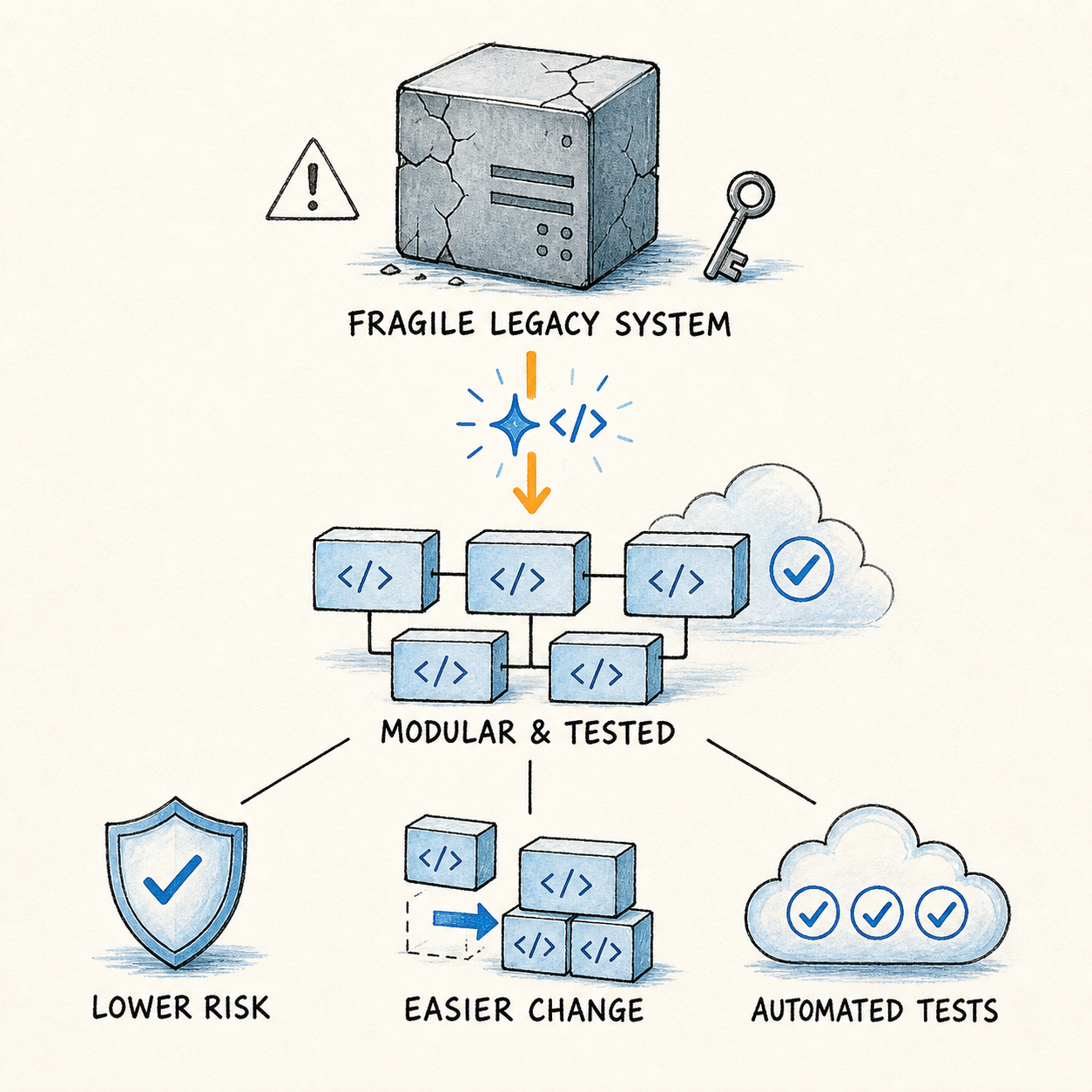 De-risking business-critical legacy system
Delivery result: a legacy system was refactored by one developer in two months. Time saving: approximately 83% faster (around 10 months saved). Cost saving: approximately 83% (around CHF 216,000 saved).
De-risking business-critical legacy system
Delivery result: a legacy system was refactored by one developer in two months. Time saving: approximately 83% faster (around 10 months saved). Cost saving: approximately 83% (around CHF 216,000 saved).
The challenge
The customer relied on a fragile legacy firmware codebase running on nRF microcontrollers. It had been maintained by one developer, was difficult to change safely and had become both an operational cost problem and a material enterprise risk.
What needed to change
- Unpredictable change cost: the customer paid CHF 135 per hour, and even small changes could result in CHF 3,000–5,000 monthly invoices with limited ability to predict or constrain the final effort.
- Single-person dependency: one developer held the practical knowledge required to maintain and evolve business-critical firmware.
- A product-launch blocker: a complex algorithm was required for a new product. After months of development without a reliable solution, the issue was blocking launch.
The approach
One software developer adopted ownership of the full codebase and used AI-assisted engineering to analyse and refactor the legacy embedded C firmware. The previously blocked algorithm was solved in one week, while the wider codebase was modularised and rebuilt over two months. Hundreds of automated test cases were introduced and executed in cloud-based test environments.
The outcome
- The complete firmware codebase was refactored in two months by one developer.
- A launch-blocking algorithm was solved in one week, removing a major risk to the new product.
- The single-person maintenance dependency was removed, while code quality and maintainability improved through modularisation and automated validation.
- Hundreds of cloud-executed automated tests created repeatable confidence that firmware behaviour remained correct as the system evolved.
Conventional delivery estimate
A comparable human-only refactoring programme was estimated at approximately 12 months. At the customer’s historical rate of CHF 135 per hour, this equates to approximately 1,920 hours and CHF 259,200, compared with approximately 320 hours and CHF 43,200 for two months of AI-assisted work.
The savings
- Approximately 83% faster delivery: two months instead of an estimated 12 months, saving around 10 months.
- Approximately 1,600 development hours avoided: around 320 hours of AI-assisted work instead of an estimated 1,920 hours.
- Approximately 83% lower refactoring cost: CHF 43,200 instead of CHF 259,200, saving around CHF 216,000.
The adoption challenge
AI-assisted embedded development still requires experienced engineering judgment. All AI-generated firmware code was reviewed against hardware constraints, memory use, timing behaviour, safety requirements, and device-level test results. AI did not replace engineering accountability; it enabled one developer to understand, refactor, test and evolve a fragile firmware codebase at a speed that would otherwise have required a far longer and riskier programme.
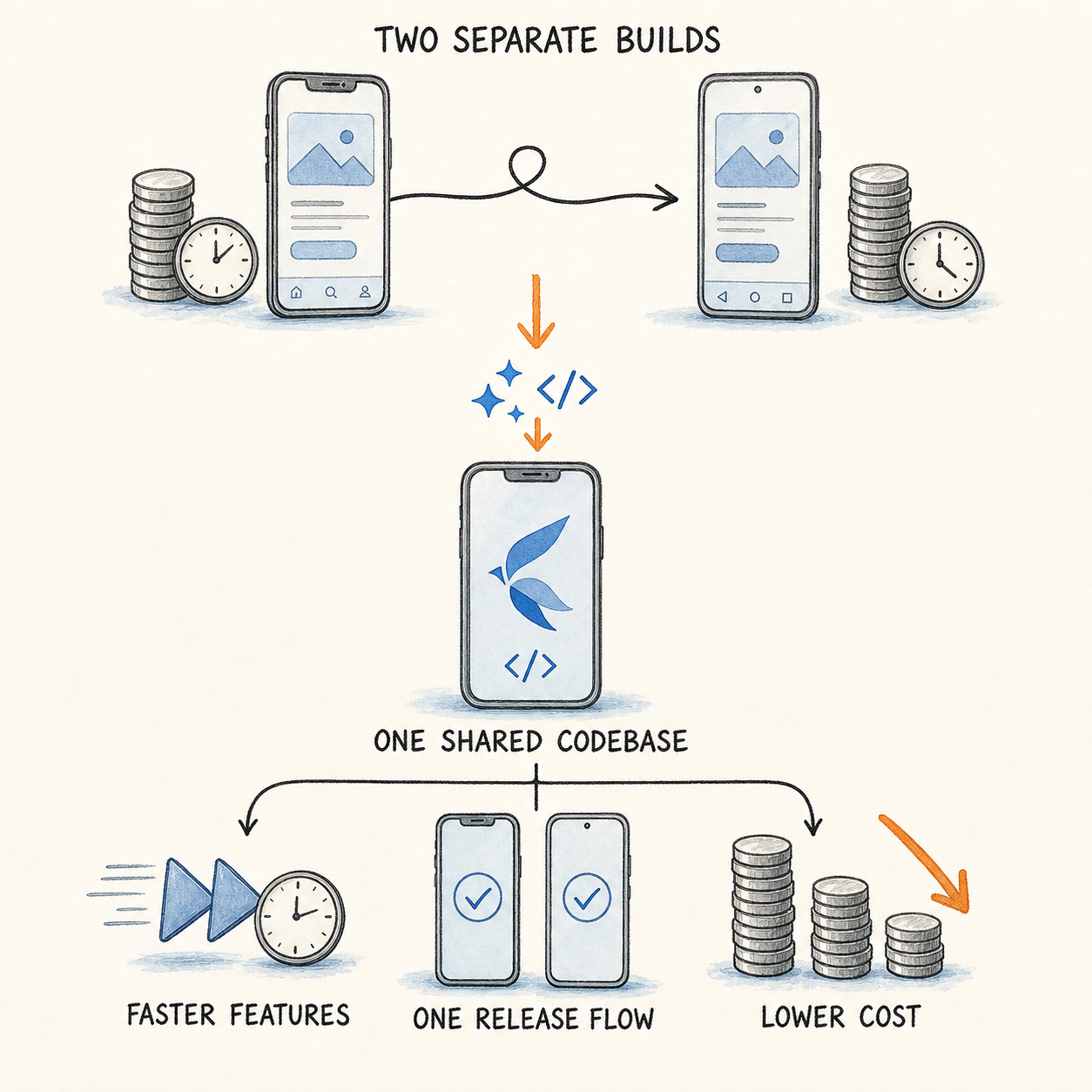 Taking control of an expensive dual-platform mobile application
Delivery result: a separately maintained iOS and Android application was refactored into Flutter in approximately two months. Time saving: future features became approximately six times faster. Cost saving: internal engineering was approximately 30% cheaper than the external supplier.
Taking control of an expensive dual-platform mobile application
Delivery result: a separately maintained iOS and Android application was refactored into Flutter in approximately two months. Time saving: future features became approximately six times faster. Cost saving: internal engineering was approximately 30% cheaper than the external supplier.
The challenge
The customer was dependent on expensive external support for a mobile application maintained as two separate native codebases: one for iOS and one for Android. The customer lacked practical control over the codebase, its build process and the true effort required to make changes.
What needed to change
- High and duplicated delivery cost: external development was charged at CHF 175 per hour per platform. For changes required in both applications, the effective delivery rate was approximately CHF 350 per equivalent feature hour.
- Small changes became expensive: even modest enhancements could result in monthly bills of approximately CHF 10,000.
- Unpredictable delivery: comparable features were typically quoted at around three times the time required once the internal team had taken ownership.
The approach
One internal developer used AI to build and compile the existing codebase, analyse its structure and establish a clear view of the current iOS and Android applications. Small changes could then be estimated and delivered internally with predictable effort and cost. The application was subsequently refactored into Flutter over approximately two months, replacing the two separate codebases with one shared cross-platform application.
The outcome
- One internal developer took ownership of the existing iOS and Android application estate.
- Small feature delivery became predictable in both time and cost, with estimates approximately three times faster than the previous external delivery model.
- The application was refactored to Flutter in approximately two months, creating one shared codebase for iOS and Android.
- Ongoing feature delivery became approximately six times faster: native work could not simply be parallelised. Each feature had to be designed, implemented and validated on one platform before it could be adapted, tested and released on the other. One Flutter codebase removed this serial two-platform workflow.
The cost baseline
Internal engineering cost was approximately 30% lower than the external supplier’s rate. The external supplier charged CHF 175 per hour per platform, or approximately CHF 350 per equivalent feature hour when the same work was required for both iOS and Android. The Flutter refactoring was completed internally over approximately two months.
The savings
- Approximately 30% lower delivery cost: internal engineering was approximately 30% cheaper than the external supplier for comparable work.
- Approximately three times faster initial feature delivery: internal ownership and AI-assisted analysis made estimates and change delivery substantially more predictable.
- Approximately six times faster future feature delivery: one Flutter codebase replaced a serial iOS-then-Android design, implementation, validation and release cycle.
- Tens of thousands of CHF in future savings potential: a sixfold reduction in the effort behind a CHF 10,000 external feature bill represents approximately CHF 8,300 of avoided external spend per comparable future change, before internal delivery cost.
The adoption challenge
The remaining bottleneck was release operations: every mobile release still required manual preparation, submission and publication through the Apple App Store and Google Play. AI could accelerate development, but it could not remove this external release process. AI-generated code could occasionally add unnecessary complexity, but this was a deliberate business trade-off: prioritise speed, lower cost and earlier product change, then refine individual areas of the shared codebase over time.
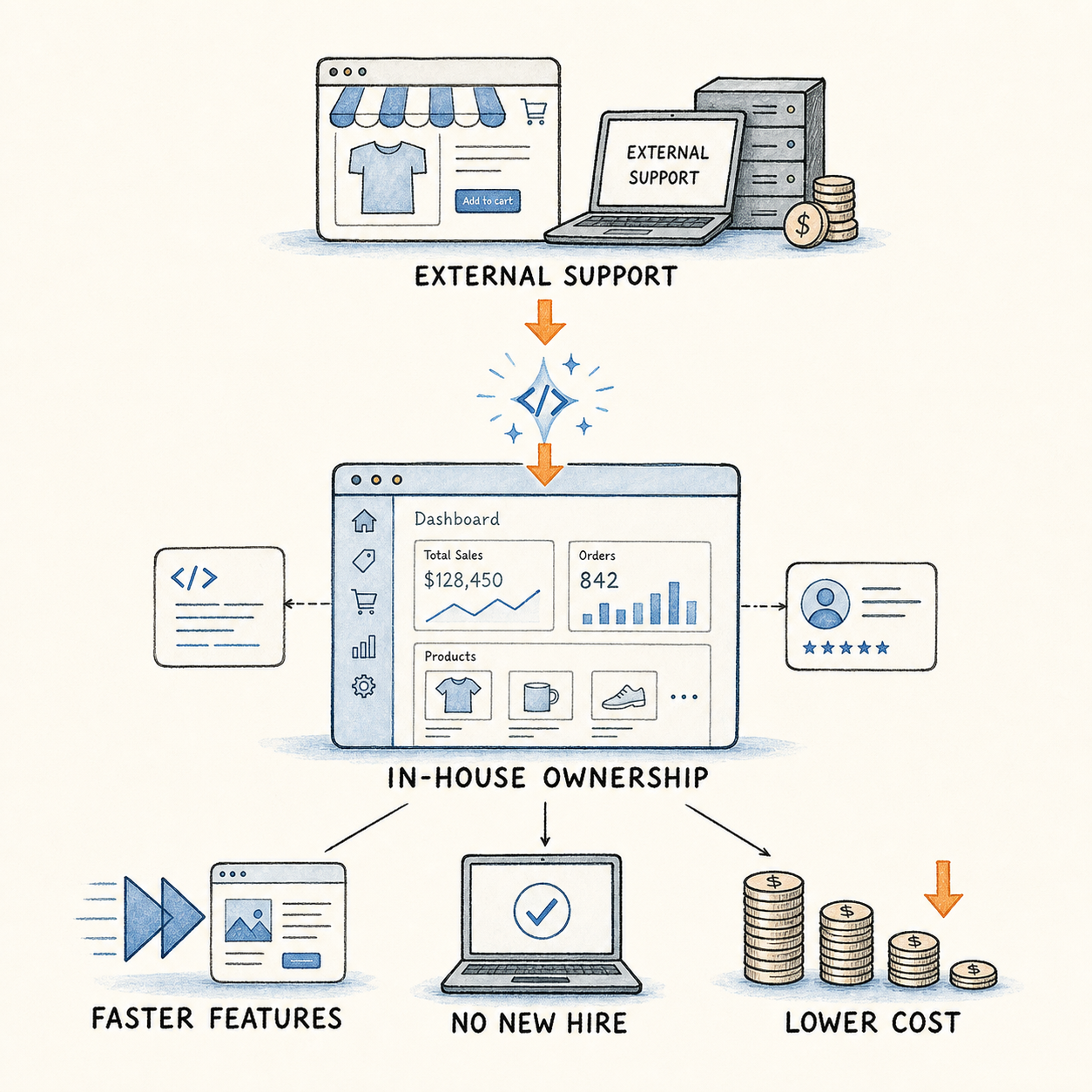 Taking ownership of a Shopify product without adding specialist headcount
Delivery result: an internal full-stack developer took ownership of a Shopify-based commerce product. Time saving: new features were delivered approximately two to three times faster. Cost saving: development cost was approximately 30% lower, without hiring a dedicated Shopify specialist.
Taking ownership of a Shopify product without adding specialist headcount
Delivery result: an internal full-stack developer took ownership of a Shopify-based commerce product. Time saving: new features were delivered approximately two to three times faster. Cost saving: development cost was approximately 30% lower, without hiring a dedicated Shopify specialist.
The challenge
An external supplier had completed the initial Shopify installation, but the customer had no internal engineering capability for Shopify-specific development. Maintenance, customer-portal changes, Shopify applications, enterprise integrations and new commercial features all depended on external support.
What needed to change
- External dependency: the customer paid external fees for ongoing maintenance and every new feature.
- A specialist capability gap: there was no internal experience with Shopify, Liquid templates, Shopify applications, customer-account pages or platform integrations.
- Limited product control: customer-facing commerce changes could not be delivered independently by the internal team.
The approach
An internal full-stack developer used AI-assisted engineering to understand the existing Shopify configuration, theme structure, Liquid templates, customer portal and enterprise integration points. The developer then took responsibility for maintenance and new features, including portal improvements, Shopify applications and integrations.
The outcome
- An internal full-stack developer took ownership of a product previously dependent on external Shopify specialists.
- Maintenance cost was reduced by moving ongoing work from the external supplier to the internal team.
- Development cost was approximately 30% lower than the external supplier’s rate.
- New features were delivered approximately two to three times faster.
- The customer avoided hiring a dedicated Shopify specialist while gaining the ability to maintain and evolve a core digital product internally.
Conventional delivery model
Without AI assistance, the customer would typically continue paying an external Shopify specialist for maintenance, portal changes, applications, integrations and new features—or hire or contract a dedicated Shopify engineer with Shopify, Liquid, application-development and integration expertise. Both options create either an ongoing external dependency or a new specialist hiring requirement.
The savings
- Approximately 30% lower development cost compared with the external supplier’s rate.
- Approximately two to three times faster feature delivery, reducing waiting time for commercial and customer-experience changes.
- Lower maintenance cost through internal ownership of the product.
- Avoided specialist headcount: the customer did not need to hire a separate Shopify/Liquid engineer to gain control of the platform.
The adoption challenge
Shopify development has its own ecosystem, including Liquid templates, theme architecture, storefront and customer-account patterns, applications, platform APIs and integration constraints. AI did not replace the need to review platform-specific implementation choices, security, customer data handling, checkout behaviour and integration reliability. It enabled an experienced full-stack developer to become effective in a specialist ecosystem quickly enough for the customer to take ownership, control cost and accelerate product delivery.
Value proposition
I help
CEOs, CTOs and CIOs
Turn technology investment into faster delivery, lower cost and stronger products.
-
Technology and delivery assessment
Establish a clear view of platform health, engineering effectiveness, cost drivers, delivery bottlenecks and execution risk.
-
AI opportunity and adoption roadmap
Identify where AI can materially improve delivery, modernisation and engineering productivity—and turn it into a practical, governed plan.
-
Technology, product and platform direction
Set or reset the architecture, product, data and platform decisions needed to support commercial priorities.
-
Modernisation and cost optimisation
Reduce the cost and risk of legacy platforms, cloud estates and engineering delivery while improving capacity for change.
-
Execution leadership for critical initiatives
Bring structure, technical leadership and decisive governance to complex programmes that are late, stalled or difficult to govern.
-
Engineering and product operating model
Strengthen leadership, teams, vendors, ways of working and accountability so delivery becomes predictable.

About Tzvetan Horozov
Technology leadership across start-ups, scale-ups and global enterprises.
CTO and technology, engineering and product leader with 20+ years of experience turning complex technology ambition into reliable commercial delivery.
- 20+ years
- CTO, technology, engineering and product leadership
- 50+ people
- Engineering and product organisations led
- 1M+ devices
- Connected-product platforms at scale
- 39M+ users
- Monthly users reached across 120+ countries
- 20+ patents
- Named inventor on patent applications
Background
I have built and scaled products and engineering organisations in both start-ups and large enterprises. In start-ups, I have turned deep technology into robust, enterprise-grade products and platforms; in larger organisations, I have modernised complex technology, teams and delivery models.
Industry experience
Technical experience
- AI-assisted software delivery, intelligent automation, LLM applications and AI-driven diagnostics
- Cloud-native, distributed and event-driven platforms; microservices, APIs and real-time data processing
- Embedded and edge systems, device connectivity and Industrial IoT
- Hardware, electronics, sensors and hardware–software integration for connected products
- Web, mobile and enterprise applications; digital identity, customer platforms and field-service systems
- Data platforms, analytics, ETL/ELT, data modelling and enterprise integration
- DevOps, CI/CD, automated testing, observability, cybersecurity and operational resilience
Experience across