Projects & Results
Selected work shows how AI can reduce delivery cost, accelerate change and give organisations greater control of critical technology.
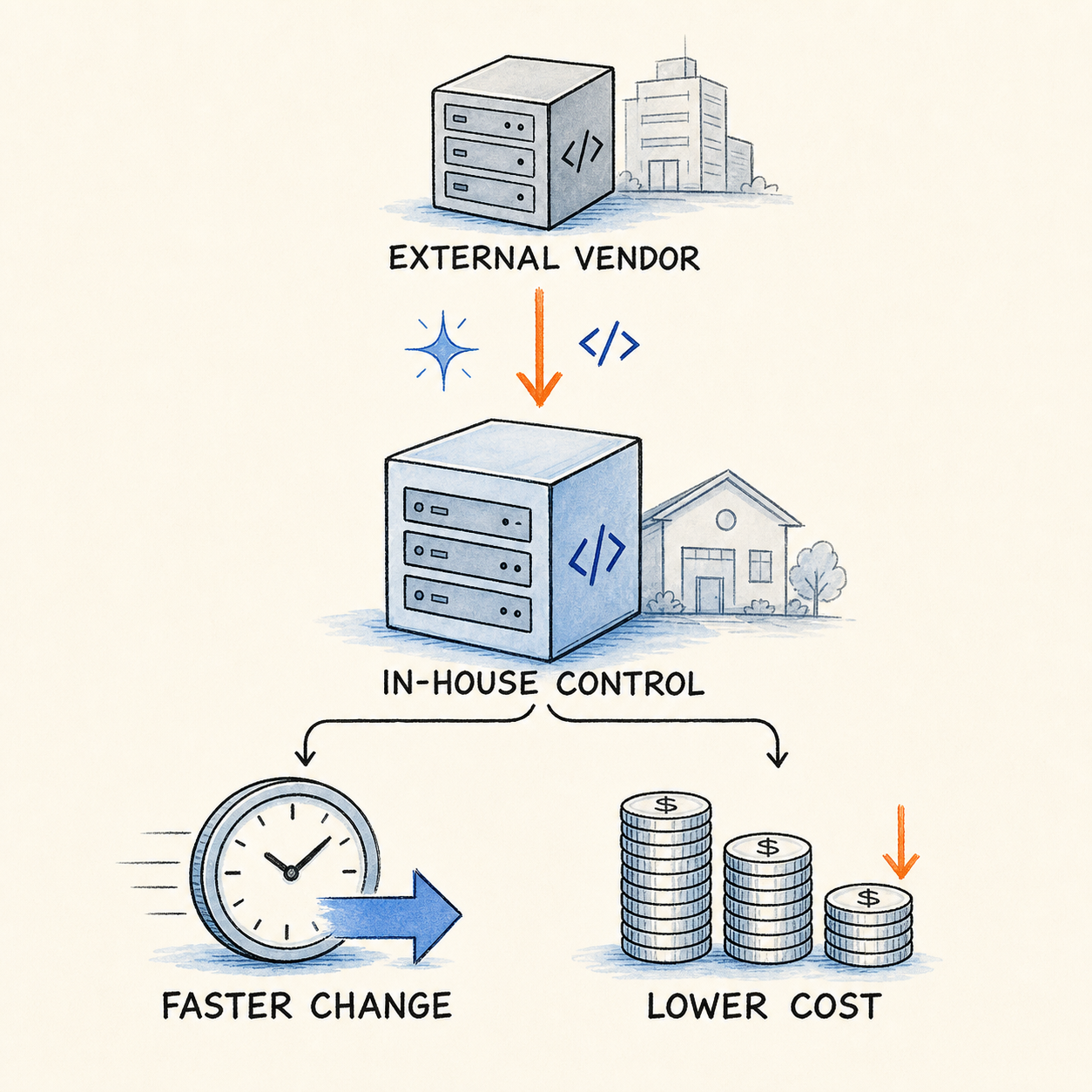 Bringing a core enterprise system in-house
Delivery result: a business-critical system was brought in-house. Time saving: approximately 50% faster (around one month saved per feature). Annual operating-cost saving: approximately 72%. Annual feature-delivery saving: CHF 360,000 in avoided external feature-delivery cost.
A core enterprise solution had been developed by an external vendor over two years at a cost of approximately CHF 400,000. Continuing ownership cost around CHF 41,120 per year: approximately CHF 20,000 in per-device licences, which increased as the number of connected IoT devices grew, plus vendor support at CHF 220 per hour. A requested new feature was estimated at two months and CHF 60,000. At that rate, a year of continuous feature work would have cost CHF 360,000.
The internal DevOps team initially hesitated to take ownership of vendor-built code and needed to invest time in deployment. AI-assisted analysis quickly built confidence, while the service continued to meet its required SLA.
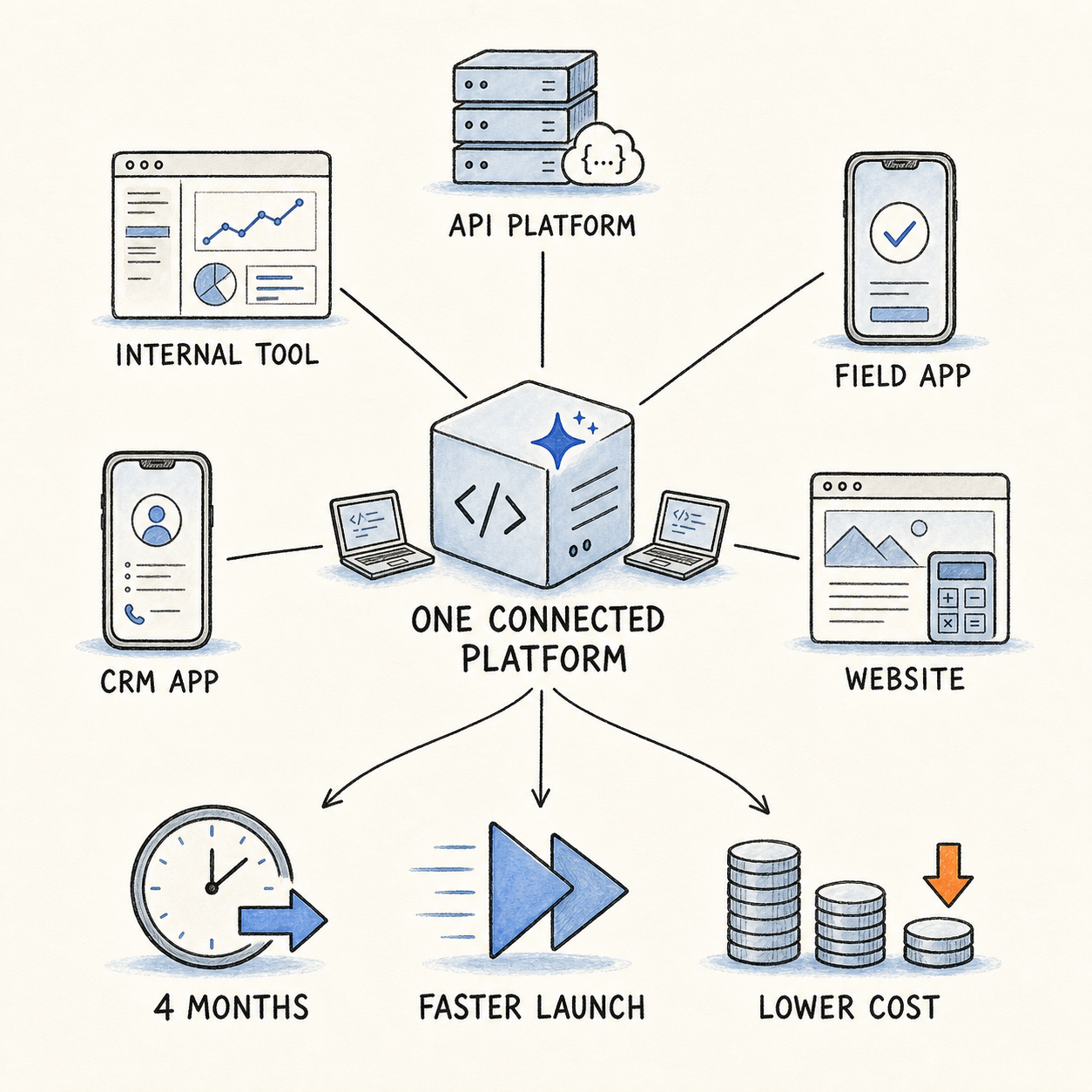 Delivering a complete operating platform
Delivery result: five connected products were delivered by two full-stack engineers in four months. Time saving: approximately 70% faster (around 12 months saved). Cost saving: approximately 85% (around CHF 300,000 saved).
An operations-heavy services business needed one connected digital platform to manage its full customer and delivery lifecycle: lead generation, quotations, sales, project delivery, field work, financial administration, and communications with customers and contractors.
Two full-stack engineers used AI coding agents throughout design, implementation, API and ERP integration, testing, defect resolution and release preparation. This allowed a lean team to work across backend, web, mobile and website delivery without waiting for separate specialist handoffs.
Without AI assistance, comparable functional scope would typically require 50–65 engineer-months spread over a 12–18-month programme. It would need a core team of senior engineers plus access to backend and ERP-integration, React, Flutter/mobile, public-web, QA and release-engineering skills. At the same CHF 6,000 monthly engineering cost, the estimated direct engineering cost would be CHF 300,000–390,000.
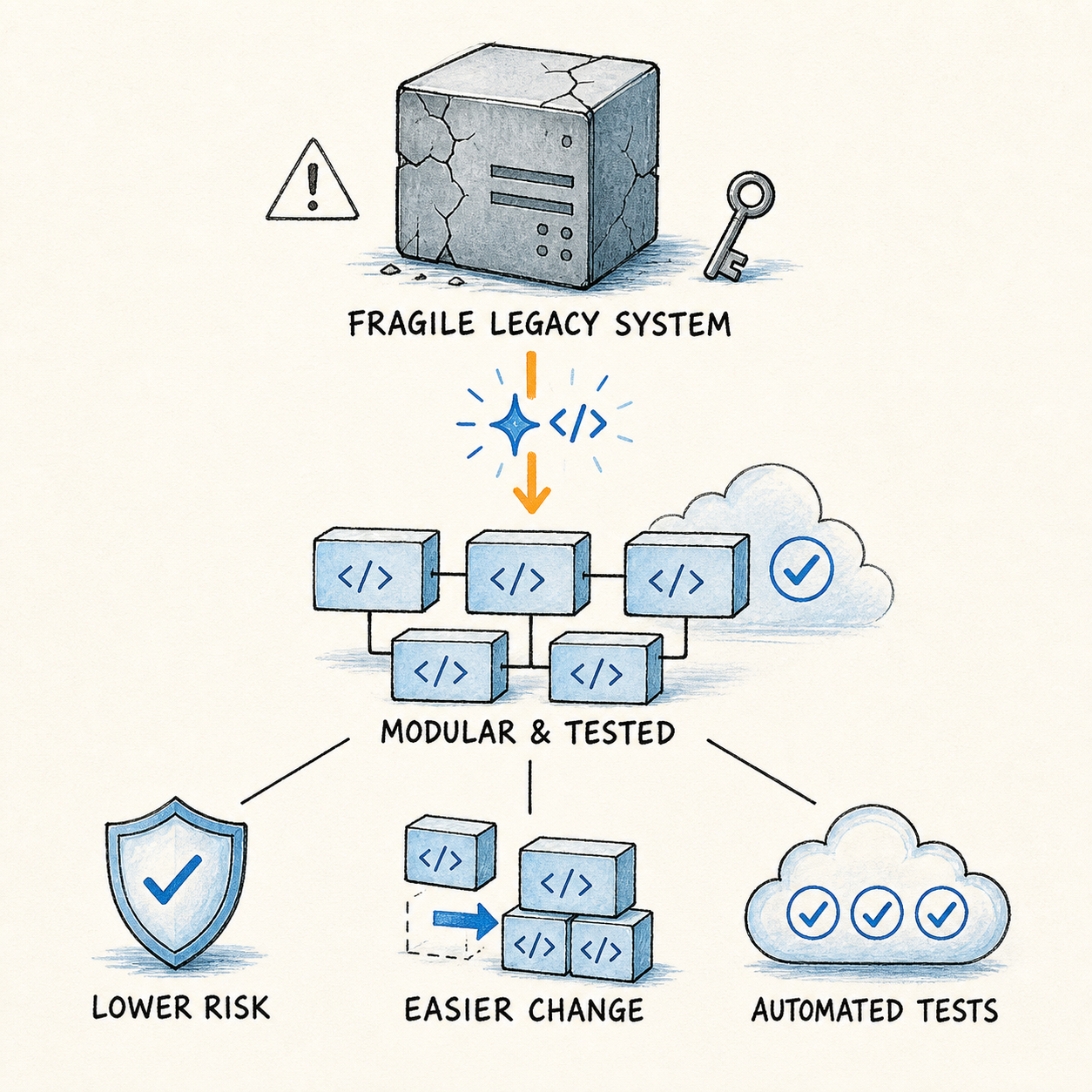 De-risking business-critical legacy system
Delivery result: a legacy system was refactored by one developer in two months. Time saving: approximately 83% faster (around 10 months saved). Cost saving: approximately 83% (around CHF 216,000 saved).
The customer relied on a fragile legacy firmware codebase running on nRF microcontrollers. It had been maintained by one developer, was difficult to change safely and had become both an operational cost problem and a material enterprise risk.
One software developer adopted ownership of the full codebase and used AI-assisted engineering to analyse and refactor the legacy embedded C firmware. The previously blocked algorithm was solved in one week, while the wider codebase was modularised and rebuilt over two months. Hundreds of automated test cases were introduced and executed in cloud-based test environments.
A comparable human-only refactoring programme was estimated at approximately 12 months. At the customer’s historical rate of CHF 135 per hour, this equates to approximately 1,920 hours and CHF 259,200, compared with approximately 320 hours and CHF 43,200 for two months of AI-assisted work.
AI-assisted embedded development still requires experienced engineering judgment. All AI-generated firmware code was reviewed against hardware constraints, memory use, timing behaviour, safety requirements, and device-level test results. AI did not replace engineering accountability; it enabled one developer to understand, refactor, test and evolve a fragile firmware codebase at a speed that would otherwise have required a far longer and riskier programme.
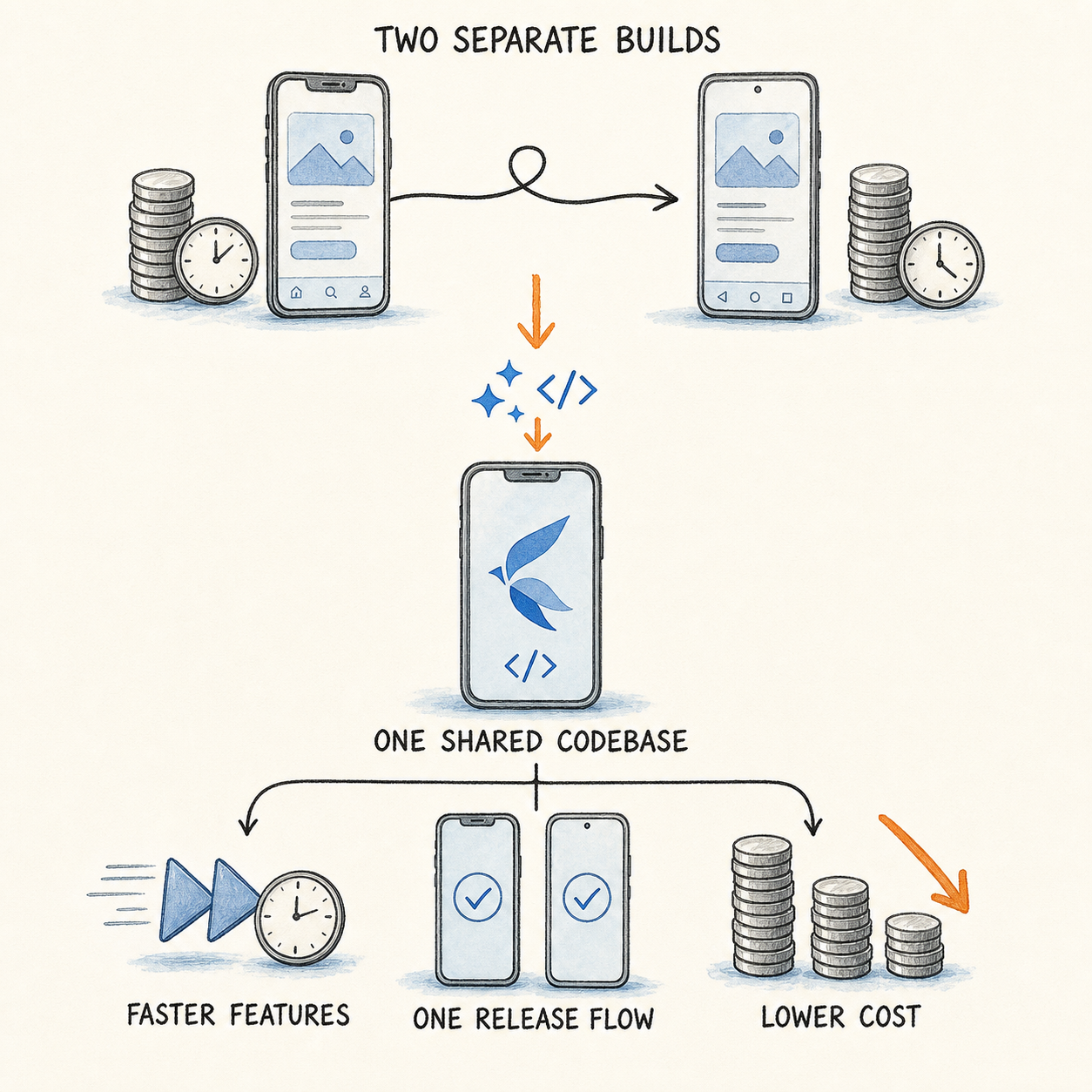 Taking control of an expensive dual-platform mobile application
Delivery result: a separately maintained iOS and Android application was refactored into Flutter in approximately two months. Time saving: future features became approximately six times faster. Cost saving: internal engineering was approximately 30% cheaper than the external supplier.
The customer was dependent on expensive external support for a mobile application maintained as two separate native codebases: one for iOS and one for Android. The customer lacked practical control over the codebase, its build process and the true effort required to make changes.
One internal developer used AI to build and compile the existing codebase, analyse its structure and establish a clear view of the current iOS and Android applications. Small changes could then be estimated and delivered internally with predictable effort and cost. The application was subsequently refactored into Flutter over approximately two months, replacing the two separate codebases with one shared cross-platform application.
Internal engineering cost was approximately 30% lower than the external supplier’s rate. The external supplier charged CHF 175 per hour per platform, or approximately CHF 350 per equivalent feature hour when the same work was required for both iOS and Android. The Flutter refactoring was completed internally over approximately two months.
The remaining bottleneck was release operations: every mobile release still required manual preparation, submission and publication through the Apple App Store and Google Play. AI could accelerate development, but it could not remove this external release process. AI-generated code could occasionally add unnecessary complexity, but this was a deliberate business trade-off: prioritise speed, lower cost and earlier product change, then refine individual areas of the shared codebase over time.
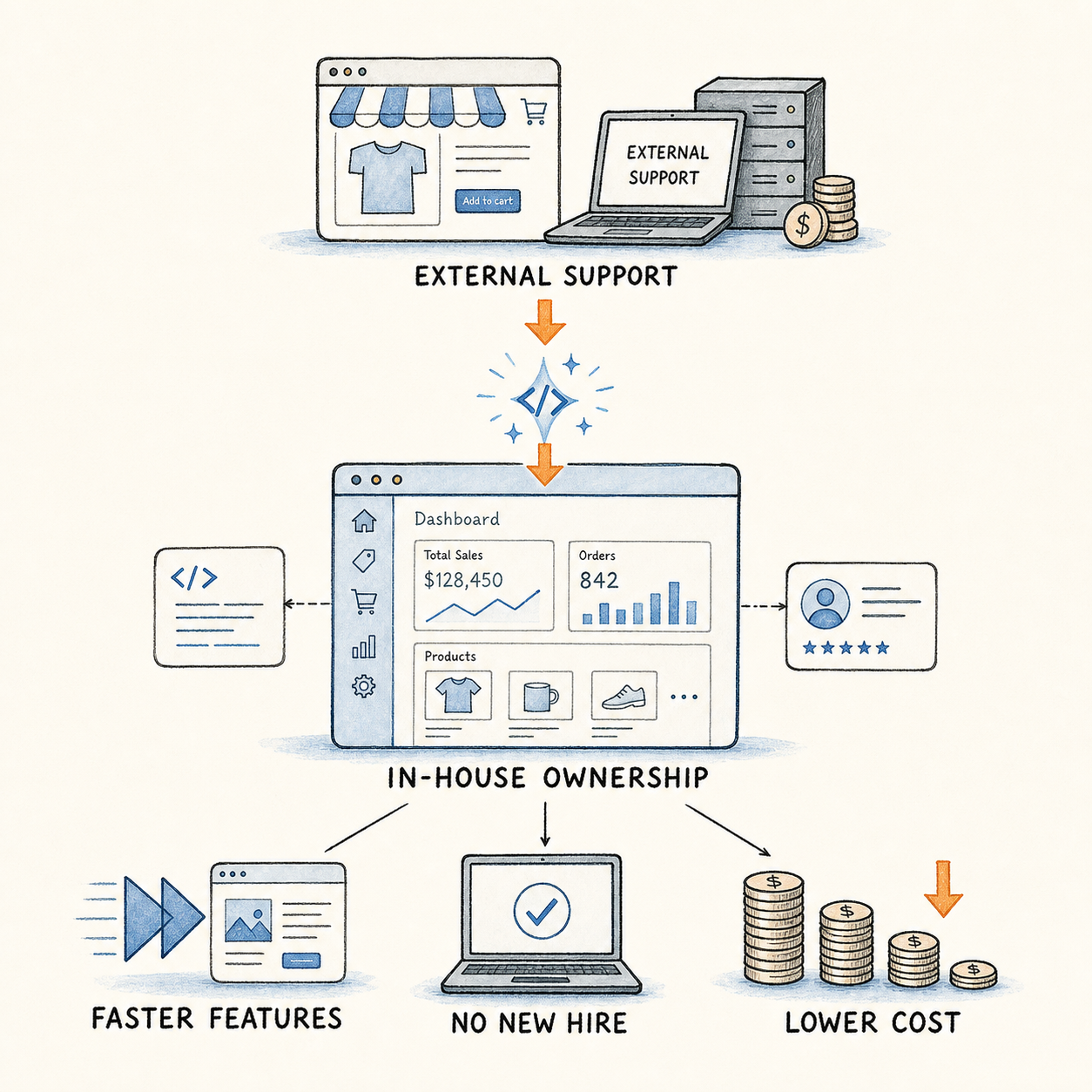 Taking ownership of a Shopify product without adding specialist headcount
Delivery result: an internal full-stack developer took ownership of a Shopify-based commerce product. Time saving: new features were delivered approximately two to three times faster. Cost saving: development cost was approximately 30% lower, without hiring a dedicated Shopify specialist.
An external supplier had completed the initial Shopify installation, but the customer had no internal engineering capability for Shopify-specific development. Maintenance, customer-portal changes, Shopify applications, enterprise integrations and new commercial features all depended on external support.
An internal full-stack developer used AI-assisted engineering to understand the existing Shopify configuration, theme structure, Liquid templates, customer portal and enterprise integration points. The developer then took responsibility for maintenance and new features, including portal improvements, Shopify applications and integrations.
Without AI assistance, the customer would typically continue paying an external Shopify specialist for maintenance, portal changes, applications, integrations and new features—or hire or contract a dedicated Shopify engineer with Shopify, Liquid, application-development and integration expertise. Both options create either an ongoing external dependency or a new specialist hiring requirement.
Shopify development has its own ecosystem, including Liquid templates, theme architecture, storefront and customer-account patterns, applications, platform APIs and integration constraints. AI did not replace the need to review platform-specific implementation choices, security, customer data handling, checkout behaviour and integration reliability. It enabled an experienced full-stack developer to become effective in a specialist ecosystem quickly enough for the customer to take ownership, control cost and accelerate product delivery.

